


The WellGuide is a reader supported publication. To receive exclusive monthly essays with mental wellness resources, consider becoming a paid subscriber.
We’re told that longing - wanting something and making an effort towards it - makes us look needy, unserious, embarassing.
Wanting someone and letting it show.
Wanting friendship enough to text first.
Wanting a creative life enough to make something bad before it becomes good.
So we mask desire with irony and distance. Yet the very things we want - love, friendship, creative aliveness - require visible wanting. And we are all caught in the paradox together: we crave deep connections while punishing the behavior that builds it.

The aesthetics of chill
The ideal right now is to appear unbothered - hard to read, low-investment, slightly unavailable, interested, but not too interested. People are rewarded for ‘being mysterious’, and seeming like nothing really touches them; as if the less you need, the more evolved you are; as if the most admirable person in the room is the one who could leave first and care the least, the most chill. We are using detachment as a way to cope out of being seen as yearning.
As a retired-chill-girl, I can tell you that detachment (appearing unbothered) might protect you from rejection, disappointment, and embarrassment; and so you remain unaffected, unharmed, in a cocoon of your own making - and you remain alone.
Because detachment prevents connection: It prevents reciprocity, because people can’t meet needs you never name.It prevents intimacy, because warmth needs visible wanting. It prevents learning, feedback, and momentum, because you never try. It prevents community, friendship depth, and being helped.
What does this look like in real life?
Romance: “I don’t care either way” protects your pride. It prevents clarity and mutual pursuit.
Friendship: Waiting to be invited protects you from feeling “too much.” It prevents the dinner that would have happened if you asked.
Work and creativity: Keeping drafts private protects you from critique. It prevents iteration and opportunities.
Community: Not initiating a meetup protects you from awkwardness. It prevents a third space from forming.
Reflection exercise: How can I let myself be seen without abandoning my boundaries?
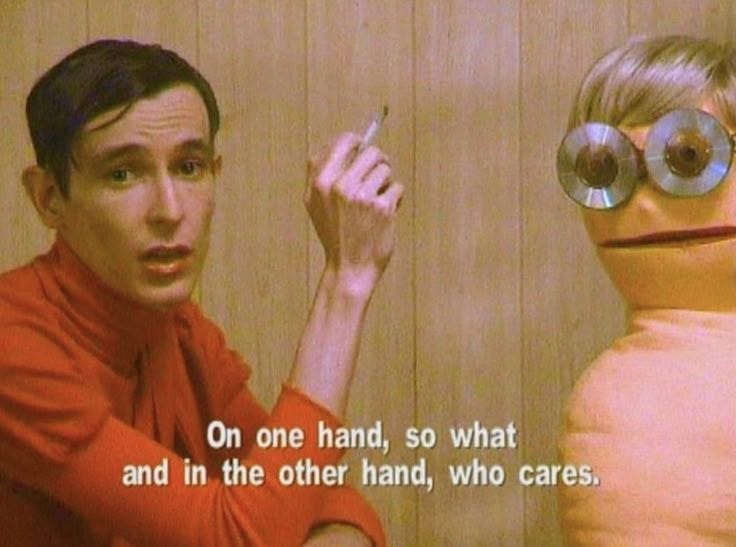
Fear stack: seen, judged, trying
I think what sits beneath this whole “yearning is cringe” discourse is not one fear, but a layered one.
Fear of being seen
Research on fear of negative evaluation, one of the core mechanisms in social anxiety, shows that many people become vigilant in anticipation of judgment, not only in response to it. The mind starts scanning for risk before anything has even happened. We monitor ourselves, rehearse, pre-edit, and imagine the audience before we make the move. Which is why something as small as texting first, asking someone out, or sharing a draft can feel much bigger than it is.
Fear of being judged
Attachment research helps explain why some people confuse desire with danger. When closeness has historically come with criticism, inconsistency, emotional withholding, or shame, the mind learns that wanting is costly. More recent research on attachment, rejection sensitivity, and fear of intimacy suggests that insecure attachment can make people more likely to expect rejection and, in turn, protect themselves from closeness before closeness even has a chance to form. That is part of why ambiguity can feel safer than clarity because a vague connection preserves possibility while a clear conversation risks a clear no.
Fear of trying
The fear of trying may be the most under-discussed layer of all. In psychology, concepts like experiential avoidance and self-handicapping describe what happens when we organize our behavior around avoiding uncomfortable internal states, especially shame, failure, and exposure. We delay, downplay, detach, and opt out, not necessarily because we do not care, but because caring raises the stakes. If I never fully try, the outcome says less about me. If I keep the work private, I never have to metabolize critique. If I act casual, I can pretend I was never invested. These are not random habits, they are protective behaviours, and in the short term they work. They reduce discomfort, preserve pride, and create distance from the possibility of humiliation. But over time, they also narrow your life. They keep you from the very experiences that would expand your tolerance for visibility, reciprocity, and creative risk.

[Reflection exercises] Pick one place you’re “protecting.” Name the fear in one sentence. Then take a 1-step visible action that respects your boundary and invites connection: send the text, make the ask, share the draft, plan the coffee. Write down what you feared, what happened, and what you learned.
Yearning in real life
Romance and masculinity
There was a period, especially in the late 1990s and 2000s, when mainstream culture briefly made more room for ornamental, emotionally expressive, even slightly softened versions of straight masculinity - the metrosexual man. What has changed since then is a much harder script, reinforced by an online ecosystem that packages masculinity as a project of domination, optimization, and status maintenance. There has been an entire cultural current teaching men to relate to themselves as brands, bodies, systems, and projects to optimize: more discipline, control, status, data. On the flip side, this demands less dependence, less tenderness, and vulnerability gets framed as weakness unless it can be converted into a “strategy”.
Researchers studying masculinity norms have found that ideals like self-reliance, invulnerability, and emotional suppression can limit men’s capacity for connection. In that framework, manhood is not treated as a stable identity but as a social status that must be repeatedly proved and can be easily threatened. If masculinity feels contingent, then tenderness is not just an emotion, it is a reputational risk. But what is so threatening about yearning in today’s masculinity, especially, is that it interrupts the script of dominance. It asks for receptivity and emotional exposure. So detachment becomes a kind of social insurance policy. Vagueness, unreliability, ironic distance, even self-deprecation can function as micro-armors because they preserve masculine credibility in a culture that sees open desire as weakness.
You can see this in the way male group culture often still polices tenderness through ridicule. The recent backlash around the U.S. men’s Olympic hockey team was not just about one “locker-room moment”, but it was more about what that moment revealed. It showed how easily masculine bonding can still cohere around minimizing women, even when those women achieved the exact same victory. That is the larger pattern: if femininity is positioned as lower status, then anything associated with women, including emotional openness, romantic expressiveness, and visible devotion, becomes easier to diminish, mock, and avoid.
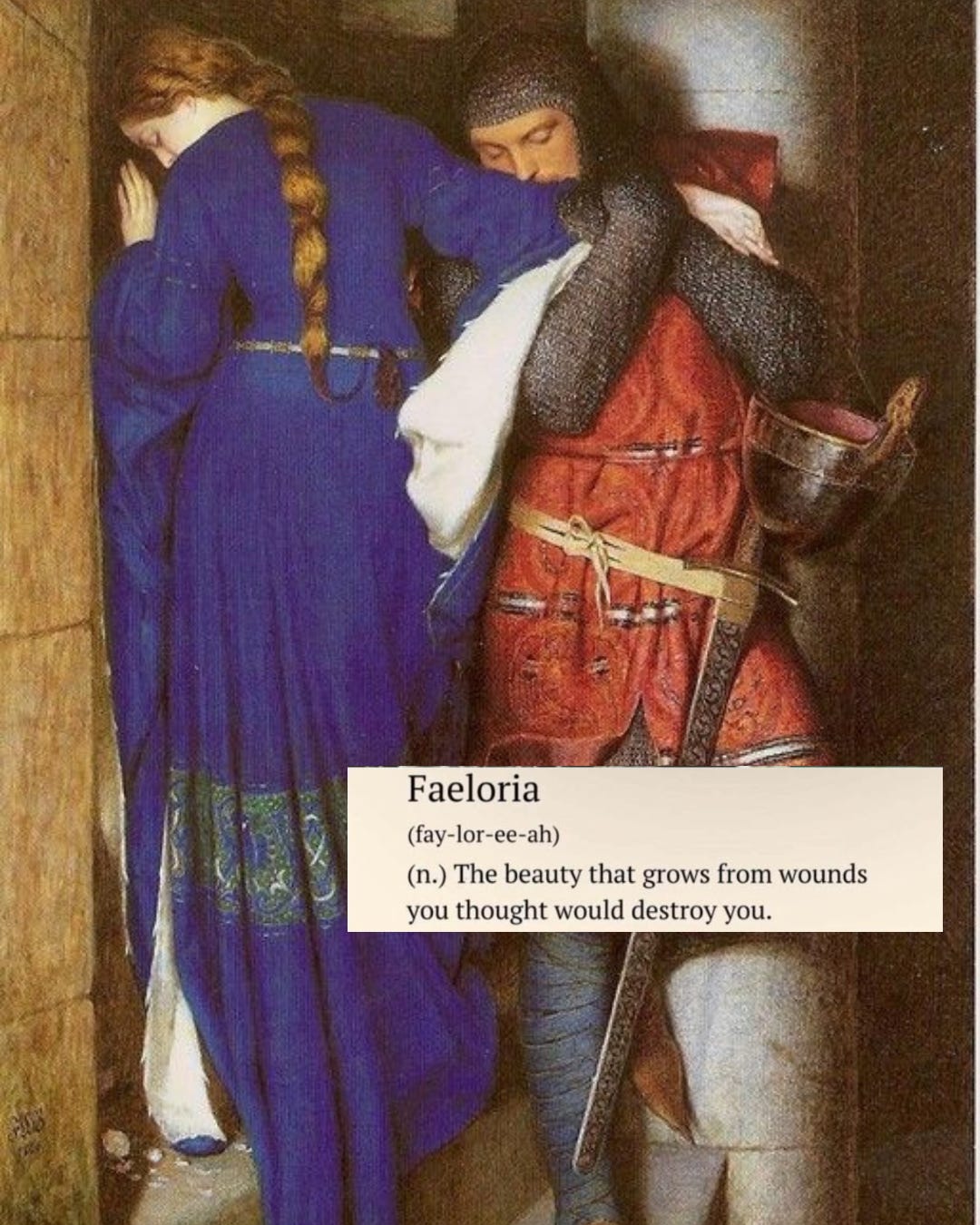
Which is also why yearning in media remains so charged. The longing man in a period drama, the Bridgerton gaze, the man who looks wrecked by love instead of above it, still has such a hold on women because yearning signals something emotionally rare in today’s world: presence, attunement, noticing, consideration, devotion, the willingness to be altered by love. So when people sneer at yearning, what they are often really sneering at is human relational basics that have become strangely scarce: steadiness, pursuit, emotional fluency, warmth, clarity, care.
In a culture where so many men are taught to relate to themselves as machines to optimize, yearning can look almost subversive. Yearning refuses the fantasy of total self-containment and reminds us that love is not only about choosing someone, it is about being changed by someone.
The WellGuide is a reader supported publication. To receive exclusive monthly essays with mental wellness resources, consider becoming a paid subscriber.
Not just in romance, but in friendships
‘Yearning is cringe’ is also ruining out friendships. So many of us want closeness but have become strangely allergic to looking like we want it. We are comfortable lamenting the loss of community in the abstract, by sharing articles on Instagram stories, but far less comfortable taking visible action that building community actually requires: the follow-up text, the clear invitation, the second ask, the honest “I’d love to spend more time together.”
Social psychologists have found that people consistently underestimate how much others like them after conversations, a bias known as the liking gap. In other words, we often walk away from an interaction assuming we were less enjoyed than we actually were. That matters because it means adult friendship is often constrained not only by actual rejection, but by anticipated rejection. This is because we are overexposed to self-consciousness. Friendship asks for something that feels emotionally expensive: initiative without guarantees. To be the eager friend is to risk misreading the room, to risk seeming overly available, to risk caring a little more than the other person does.
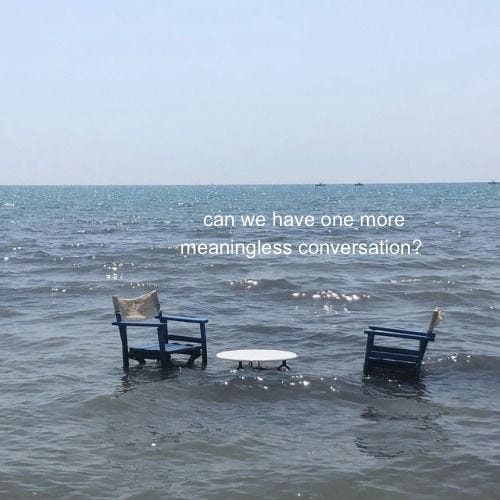
And so a lot of people end up waiting for unmistakable proof of reciprocity before they allow themselves to move toward someone, which is another way of saying we want the safety of connection without the vulnerability of building it. However, friendship, like any living thing, grows through bids: small acts of initiative that say, I want to know you better, I want to see you again, I want to make room for you in my life.
[Reflection Exercise]: When was the last time you made an explicit bid for friendship? What were you afraid of, and what actually happened?
Think of one new-ish friend and make an explicit effort to connect with them this week.
This of an old friend / friend group and explicitly offer to organize a gathering. You can use Priya Parker tips to gather and host without stressing yourself out!
How it shows up at work and creativity
Related research on avoidance motivation makes a similar point: when our attention is organized around avoiding failure rather than moving toward possibility, creativity narrows. In professional settings, we tend to call this high standards and strategic timing. In creative settings, we call it incubation, perfectionism, “being private”, waiting until it is ready. But often what is happening underneath is much simpler: being seen as trying is visible, and visibility invites judgment. There is a reason psychologists use the term evaluation apprehension to describe what happens when the fear of being assessed by others inhibits idea generation. Research on collaborative creativity has found that when people become preoccupied with how their ideas will be received, they produce fewer ideas and fewer categories of ideas.
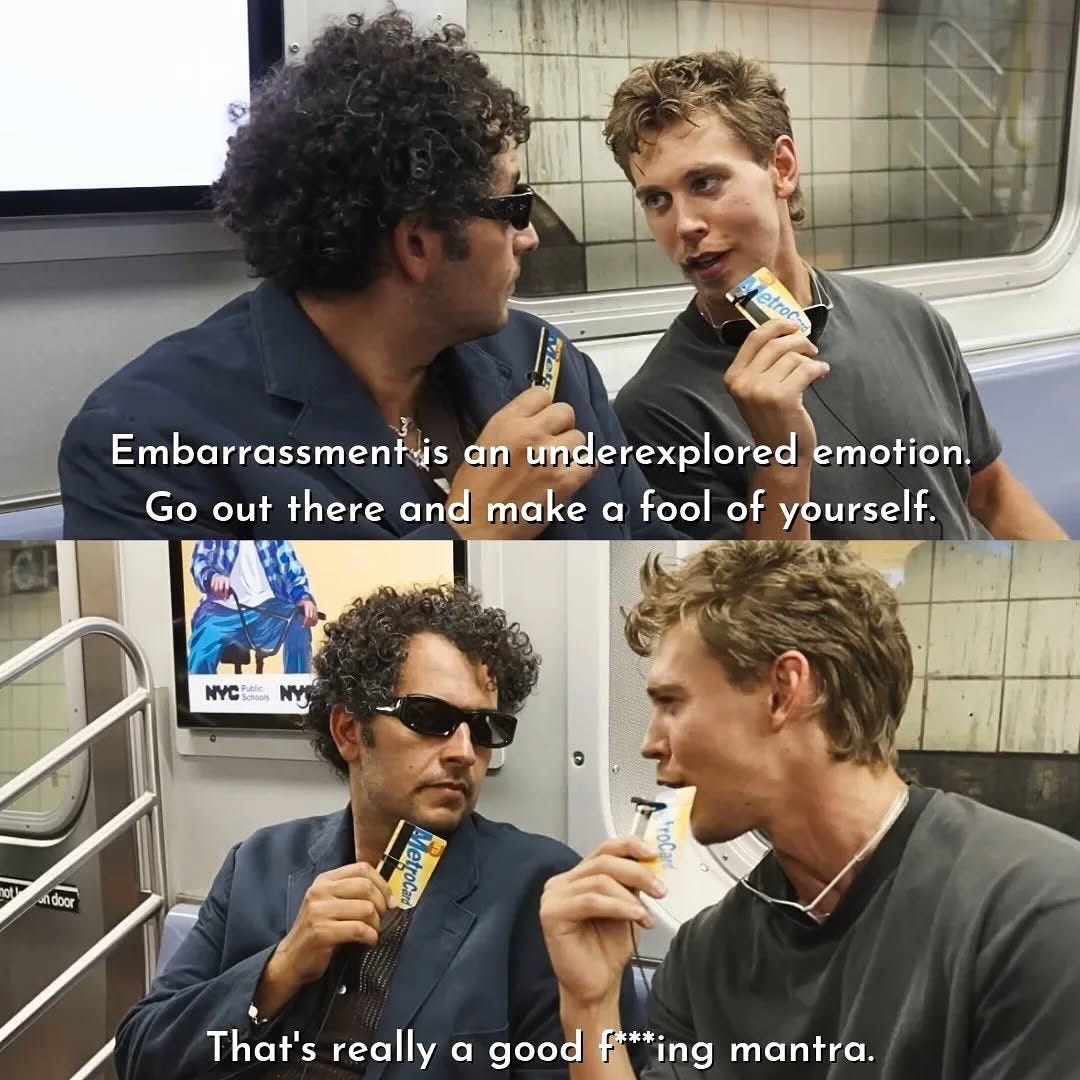
This is why I keep thinking about that Austin Butler line, or at least the version of it that has circulated so widely online, that embarrassment is an underexplored emotion and that we should go out there and make fools of ourselves. To make anything, and especially to make anything with feeling, requires a tolerance for a certain amount of cringe. Eagerness opens doors in a career, in art, in collaboration, in community. Aloofness keeps corridors empty.
Let yourself want
Maybe that is the real cost of always playing it cool: you get to protect yourself, but you also lose access to the very things that make a life feel alive. Eagerness is how communities form, how friendships deepen, how love becomes visible, and how art begins. If coolness keeps you safe, yearning is what makes you real. So come as you are, want what you want, tell people you love them, and let yourself be perceived. Connection is borne of desire, of longing - that is what propels us towards each other, and the things we love.
That’s all for now! May your tables, health, and happiness be always in abundance. Live well + be well xx,
Israa
My book, Toxic Productivity, is available everywhere books are sold. You can learn more about it here: www.israanasir.com/toxic-productivity
Cover art: Psyche Revived by Cupid’s Kiss Sculpture by Antonio Canova